Don't Feed the Fear
Don't Feed the Fear
Full episode transcripts of the Don’t Feed the Fear podcast are available here to support accessibility and inclusive listening.
#95 Traditional Chinese Medicine: Dr. Xiu-Min Li's Groundbreaking Research
In this episode, I speak with Dr. Xiu-Min Li, a physician and researcher uniquely trained in both Western medicine and Traditional Chinese Medicine (TCM). Dr. Li has spent decades conducting rigorous scientific research exploring how traditional herbal therapies may help treat allergic diseases such as food allergies and eczema.
Her work focuses on developing standardized herbal formulas and studying their effects on the immune system through laboratory and clinical research. This includes the development of Food Allergy Herbal Formula (FAHF) and other therapies being studied for conditions such as severe eczema and topical steroid withdrawal (TSW).
In this conversation, Dr. Li explains the scientific approach behind her work, how TCM concepts translate into modern immunology research, and what the future may hold for integrative treatments for allergic disease.
#94 A Parent & Psychologist’s Perspective on the Emotional Side of Food Allergy Treatment with Dr. Elizabeth Hawkins
Food allergy treatment looks very different today than it did 17 years ago.
In this episode, Dr. Elizabeth Hawkins joins me for a deeply personal conversation about navigating food allergy treatment as a parent long before many of today's options were readily available.
Elizabeth is a psychologist, celiac patient, and a celiac and food allergy parent. Her younger daughter has a complex history of multiple severe food allergies alongside asthma, eczema, and environmental allergies, and their family has navigated multiple forms of treatment. We talk about how her experiences shaped what she sees as a psychologist working with food allergy families. We also explore what parents facing immunotherapy decisions today can learn from those who have been navigating these choices for years.
This conversation is about more than choosing a treatment. It's about living with uncertainty, knowing your child, making decisions within the reality of your family's circumstances, and finding a way to move forward without letting fear make every decision for you.
#93 Helping Kids Through OIT: Fear, Coping & Building Confidence with Kelsey Mora @childlifetherapist
What does it really take to support a child through oral immunotherapy?
The medical protocol is only part of the experience. For children, OIT can involve fear, uncertainty, frustration, procedures, new sensations, and a lot of big feelings—sometimes without the words or skills to communicate what's happening.
In this episode, I talk with Kelsey Mora, a dual-certified Child Life Specialist and Licensed Clinical Professional Counselor, about the emotional and developmental side of supporting kids through food allergy treatment.
Kelsey brings nearly a decade of hospital-based child life experience together with her training as a therapist, giving her a unique perspective on helping children and families navigate medical experiences. She's also the creator of The Method Workbooks, including The Y Method, an interactive workbook designed to help children understand food allergies and immunotherapy while building communication and coping skills.
We talk about preparing children for OIT, helping kids understand what's happening in their bodies, coping with anxiety during treatment, giving children appropriate choices and control, and supporting the whole family through the process.
#92 Doing What It Takes: Advocating Through Immunotherapy and Kawasaki with Natalie Grijalva @createlikeamom
What does it look like when a family is navigating multiple complicated medical journeys?
In this episode of Don't Feed the Fear, I sit down with Natalie Grijalva to talk about her experience with her son's food allergy immunotherapy and her son's additional medical challenges related to Kawasaki disease.
Natalie started her Instagram account @createlikeamom as a space to explore and express her artistic pursuits, but motherhood led her in a different direction and she now uses the account to raise awareness about food allergies and Kawasaki.
We discuss what it takes to make treatment possible for a child when life is already complicated. We discuss the emotional and practical realities of navigating multiple medical concerns. We also talk about Kawasaki disease awareness and the importance of learning from other chronic illness communities—even when our diagnoses and experiences look different.
Many families within the food allergy community find themselves navigating their own unique combination of medical concerns. This conversation is ultimately about hope, persistence, and finding meaningful connection even though none of our stories are exactly the same.
#91 The Reality of Immunotherapy: Progress, Setbacks, and Persistence with Sarah Danna
In this episode, I sit down with Sarah Danna, the creator behind @sarahandspices, to talk about her life with food allergies, her more recent diagnosis with MCAS, and her experience with immunotherapy through the Tolerance Induction Program (TIP) at the Food Allergy Institute.
Sarah shares the emotional and practical realities of navigating treatment while also building an online community around allergy-friendly living. We talk about the progress she has experienced through the program, some of the challenges and setbacks along the way, and how her care team is adapting treatment in the context of mast cell activation syndrome.
We also discuss what it’s like to share your health journey publicly as a content creator and how community support has shaped Sarah’s advocacy.
Thank you Sarah for sharing your honest patient perspective on navigating complex allergic disease and treatment.
#90 Understanding the Tolerance Induction Program (TIP) with Dr. Inderpal Randhawa
In this episode, Dr. Inderpal Randhawa, founder of the Tolerance Induction Program (TIP) for allergies, joins the podcast to discuss his program and its approach to food allergy treatment.
As part of this season exploring emerging and evolving allergy management options, this conversation aims to provide information directly from the source. TIP has generated both interest and debate within the food allergy community.
In this episode, we discuss:
• The foundational principles of TIP
• How the program is structured
• Patient selection and goals
• How TIP fits into the broader treatment landscape
• Areas of ongoing discussion within the field
This episode does not serve as an endorsement of any specific treatment. The intention is to offer balanced access to information so families and clinicians can make informed decisions in partnership with their own medical teams.
As always, we also consider the mental health dimensions of navigating complex medical choices.
#89 Is SLIT (Sublingual Immunotherapy) Underrated? With Dr. Nikhila Schroeder
In this episode, allergist Dr. Nikhila Schroeder, founder of Allergenity Health, joins the podcast to discuss sublingual immunotherapy as a standalone treatment for food allergies.
As the second installment in our SLIT series, this conversation moves beyond introductory discussions and into a broader vision of what SLIT can offer. Dr. Schroeder shares how sublingual immunotherapy may provide meaningful protection, improved quality of life, and a lower intensity pathway for families who may not be pursuing higher-dose oral immunotherapy.
We explore:
• How SLIT works and how it differs from OIT
• Expanding SLIT beyond its traditional framing
• Which patients may benefit most from this approach
• The importance of aligning treatment with family goals
This episode is part of a larger season exploring immunotherapy options in allergy care, highlighting both the promise and the complexity of an expanding treatment landscape.
#88 Reflecting on OIT for Three with Sarah Hornung
Every family's experience with food allergy treatment is different and hearing those lived experiences can be just as valuable as knowing the research and hearing from the experts.
This week's episode welcomes back food allergy Mom and advocate Sarah Hornung, who was first featured in Episode 11. Sarah is back for this season on immunotherapy to share what it was like to guide all three of her children through oral immunotherapy for multiple foods.
Our conversation explores the realities of treatment from a parent's perspective: the challenges, the unexpected moments, the lessons learned, and how each child's journey unfolded in its own unique way.
If you're considering immunotherapy or supporting families who are, we hope this conversation offers both practical insight and reassurance that there is no one-size-fits-all treatment experience.
#87 Dr. Kara Wada on Sjögren’s, ILIT, and Reimagining Immune Care
In this episode, Dr. Kara Wada, known online as The Immune Confident MD, joins the podcast to discuss immune complexity from both the physician and patient perspective. Dr. Wada is a board-certified allergist, immunologist, lifestyle medicine physician, food allergy mom, and Sjogren's patient.
Living with Sjögren’s disease and dysautonomia herself, Dr. Wada shares how personal experience reshaped her approach to allergy and autoimmune care. We explore the intersection of conventional and integrative medicine, the emotional realities of navigating chronic illness, and the importance of compassionate, patient-centered care.
We also discuss intra-lymphatic immunotherapy (ILIT), a lesser-known but evidence-based allergy treatment that differs from traditional subcutaneous immunotherapy. Dr. Wada explains how ILIT works, who it may be appropriate for, and why it remains less widely available despite promising research.
This episode expands the conversation around immune health and personalized treatment pathways.
#86 Biologics in Food Allergy Care: A New Era with Dr. Brian Vickery
In this episode, Dr. Brian Vickery of Emory University joins the podcast to discuss biologics in food allergy treatment.
As research advances, biologics are emerging as both standalone therapies and adjuncts to other treatments such as oral immunotherapy. Dr. Vickery explains how these medications work, what they are designed to target within the immune system, and how they may shift the risk-benefit landscape for certain patients.
We also briefly discuss PEACH, a quality of life measurement tool developed to better assess the real-world impact of food allergy on families.
This episode continues our season-long exploration of evolving treatment options, with a focus on clear, balanced information to support informed decision-making.
#85 How Sublingual Immunotherapy Can Increase Safety and Freedom, With Dr. Allison Freeman
Amanda Whitehouse
Season: 8
Episode: 85
How Sublingual Immunotherapy Can Increase Safety and Freedom, With Dr. Allison Freeman
Episode Downloads
0
Total
0
Today
All allergy families are familiar with strict avoidance and emergency preparedness, and some have heard of oral immunotherapy (OIT). But fewer know about sublingual immunotherapy (SLIT) and how it may fit into a long term treatment plan.
In this episode, I sit down with allergist Dr. Allison Freeman to explore what SLIT is, how it works, and when it may be a good option for both environmental and food allergies.
Dr. Freeman is a board certified allergist and immunologist practicing in Richmond, Virginia. She has extensive experience helping patients pursue personalized immunotherapy strategies.
#84 Demystifying EoE with Dr. Christopher Parrish
In this episode, I’m joined by Dr. Christopher Parrish, a triple board-certified allergist and immunologist who leads Latitude Food Allergy Care’s Orange County clinic and has been involved in groundbreaking clinical research in both food allergy and EoE.
Dr. Parrish previously served as faculty at UT Southwestern Medical Center and helped lead a multidisciplinary program dedicated to eosinophilic gastrointestinal diseases. His work has contributed to clinical trials that ultimately led to the first FDA-approved therapies for food allergy and EoE.
In our conversation, Dr. Parrish explains:
What EoE actually is
Why it comes up so often in conversations about immunotherapy
What families and patients often misunderstand about the condition
How EoE is diagnosed and treated
How patients and clinicians think through these risks when considering immunotherapy
This episode is designed to help patients, parents, and clinicians better understand the science and the decision-making around EoE and food allergy treatment.
#83 Could Research Shift the Way You Feel About Food Allergy Treatments? with Dr. Lianne Soller
Food allergy research is constantly evolving, but what do these studies actually mean for families making treatment decisions?
In this episode of Don't Feed the Fear, I welcome Dr. Lianne Soller Allergy Research Manager at BC Children's Hospital in Canada to help us make sense of the evidence behind food allergy immunotherapy and where the field is headed. Together, we explore some of Dr. Soller and her team's most important research findings, including what we've learned about treatment outcomes, quality of life, safety, and factors that may influence success.
Rather than focusing on headlines or individual studies in isolation, this conversation highlights why becoming curious about food allergy research can help families feel more informed and confident as they navigate treatment decisions. Dr. Soller also shares insights into how research questions are developed, why evidence continues to evolve, and how families can thoughtfully interpret new findings without becoming overwhelmed.
Research helps us ask better questions, but every family's decision is still deeply personal. My hope is that this conversation helps you see the value of research-informed decisions.
#82 When "Not Right Now" is Right For Now with Ina Chung @theasianallergymom
Every family approaches food allergy treatment differently, and that's exactly as it should be.
In this episode, psychologist and food allergy mom I sit down with Ina Chung, creator of @TheAsianAllergyMom to discuss one of the most overlooked aspects of treatment decisions: giving yourself permission to choose the path that aligns with your family's goals, values, and season of life.
Together we discuss:
Why more treatment options can sometimes create more pressure
Raising confident, thoughtful children with food allergies
Helping kids become part of the decision-making process
The importance of knowing your family's goals before choosing a treatment
Why "not right now" can be a thoughtful decision
Building confidence instead of comparison
#81 Mindset and Mental Health in OIT with Prof. Adam Fox
In this episode, UK allergist Prof. Adam Fox joins us to explore the emotional and psychsocial layers of oral immunotherapy.
Dr. Fox shares how he approaches difficult conversations with honesty and compassion, including addressing guilt about management decisions and understanding risk and side effects during treatment. Dr. Fox gives us important insights and emotional validation regarding the connection between stress and allergic reactions, including how the brain, gut, and immune system interact during treatment.
This conversation expands the discussion beyond protocols and data and into the lived emotional experience of navigating food allergy treatment.
Fear, Hope, & self-compassion: Guest host Dr. Elizabeth Hawkins Interviews me about my new book
This month, the tables are turned.
In this special episode, psychologist, food allergy mom, and friend Dr. Elizabeth Hawkins joins the podcast as guest host to interview me about my new book, From Fear to Freedom: A Workbook for Navigating Allergy Immunotherapy.
We discuss the personal and professional experiences that inspired the book, the challenges families face when considering treatment options, and why food allergy treatment decisions are about so much more than medicine alone.
Our conversation explores the role of anxiety, uncertainty, values, family dynamics, and nervous system responses in treatment decision-making. We also discuss common misconceptions about food allergy treatments, what families often struggle with most, and why there is no single "right" path for every patient.
This episode offers an honest look at the questions, fears, hopes, and possibilities that shaped both the book and the conversations it hopes to support.
Available now:
Amazon: https://a.co/d/06s0n6ac
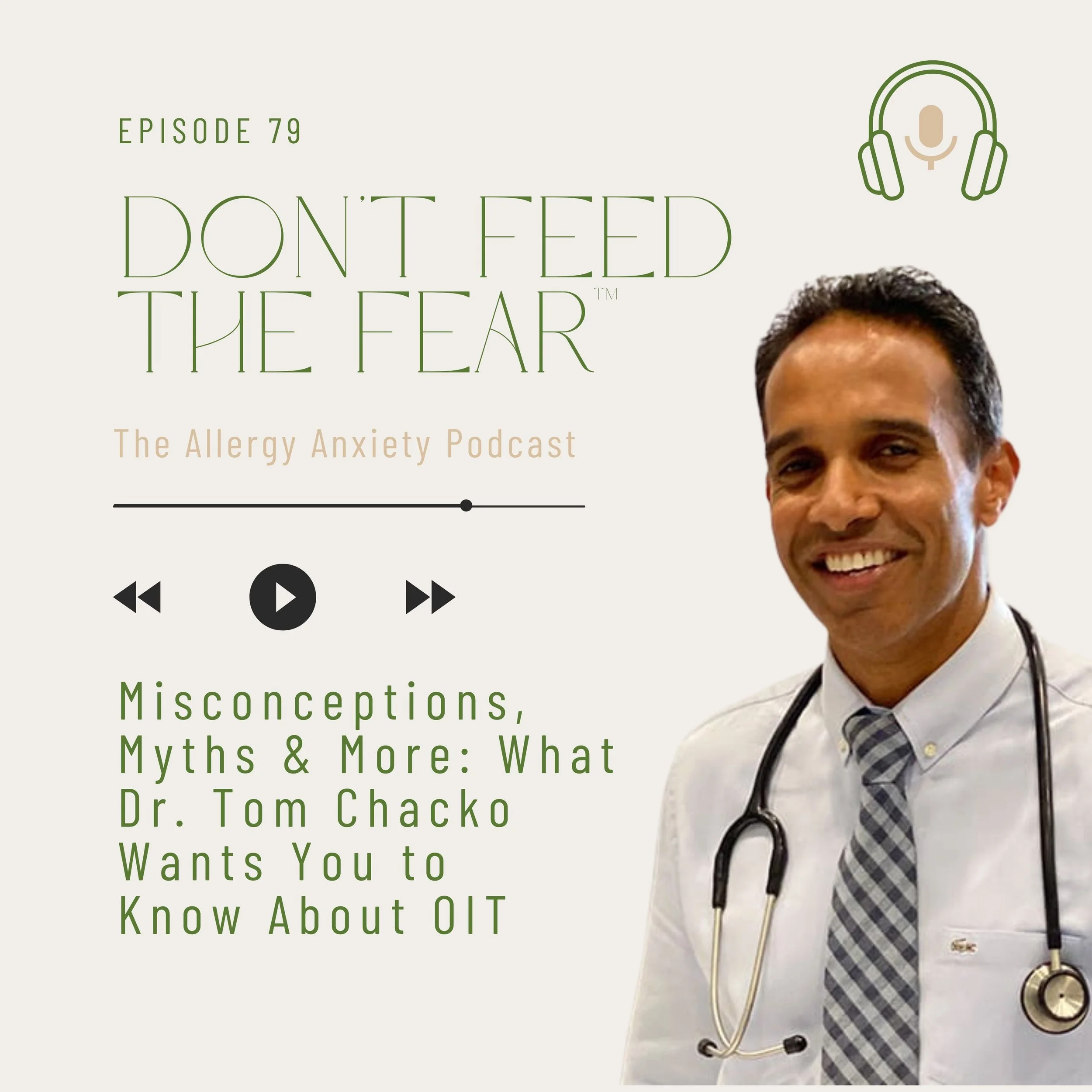
Misconceptions, Myths & More: What Dr. Tom Chacko Wants You to Know About OIT
We covered what oral immunotherapy (OIT) is last week.
This week? We’re talking about what it’s not.
Dr. Tom Chacko joins me to bust common myths about oral immunotherapy and answer the questions families ask in his clinic and on social media every day.
Dr. Chacko gives us his honest and direct perspective on:
-When not pursuing OIT could be a missed opportunity or even a disservice to a patient
-How other treatment options compare to OIT
-Why we should be mindful of where messages come from and who benefits
If allergy treatment options feel overwhelming right now, this episode will help you sort through the noise.
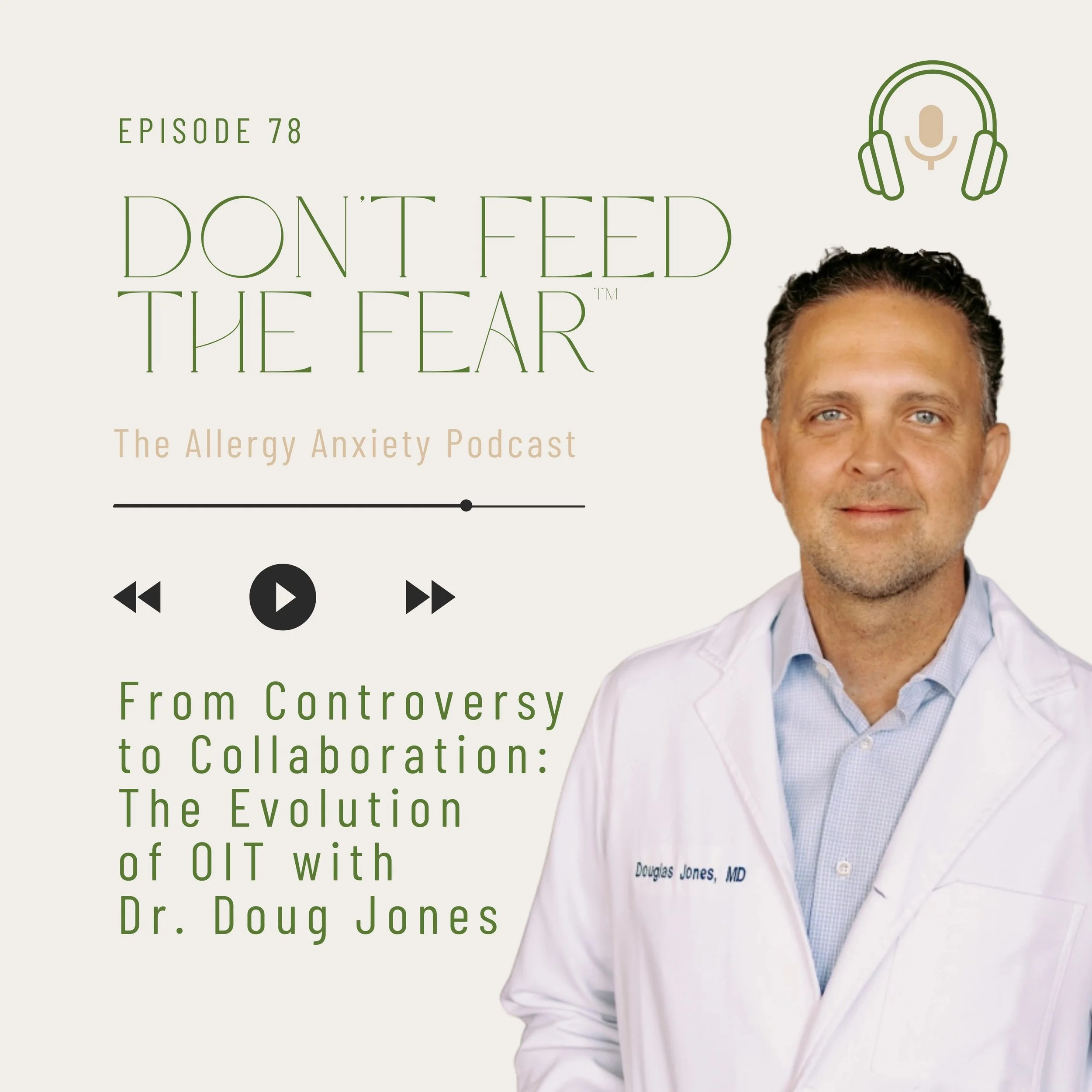
From Controversy to Collaboration: The Evolution of OIT with Dr. Doug Jones
In this episode, we begin a deep dive into specific food allergy immunotherapy treatments with a conversation about (OIT).
Dr. Doug Jones, one of the early pioneers of OIT in the United States, joins us to discuss how it looks in real clinical practice, and how to think about risk, predictability, and control in food allergy management.
As treatment options expand, patients and clinicians alike are navigating increased complexity. This conversation offers a grounded, evidence-based framework for thinking through OIT and shared decision-making. Dr. Jones acknowledges the psychological impact of allergy trauma and management, and helps us to understand the difference between accidental exposure risk and structured treatment risk
This episode is for anyone feeling overwhelmed by treatment decisions and wanting a clearer framework for thinking about OIT.
My Month of Awareness & Why It Matters
In this solo episode, I’m wrapping up an incredibly meaningful awareness month by taking you behind the scenes of the advocacy events, conferences, legislation, research, and community moments that left me feeling hopeful about the future of food allergies and chronic illness care.
From the Food Allergy Fund Summit in New York City, to advocacy days in Washington DC and Albany, this episode explores the intersection of mental health, medical advocacy, innovation, storytelling, and policy change across the food allergy, celiac, asthma, eosinophilic disease, and alpha-gal communities.
I also share personal reflections from traveling with loved ones, bringing my son to advocacy events, and witnessing children and teens become the next generation of leaders in this space, as well as the challenging emotions of acknowledging the tragic losses our advocacy honors.
This episode is both a recap and a reminder:
progress is happening because people continue to care, speak up, and advocate together.
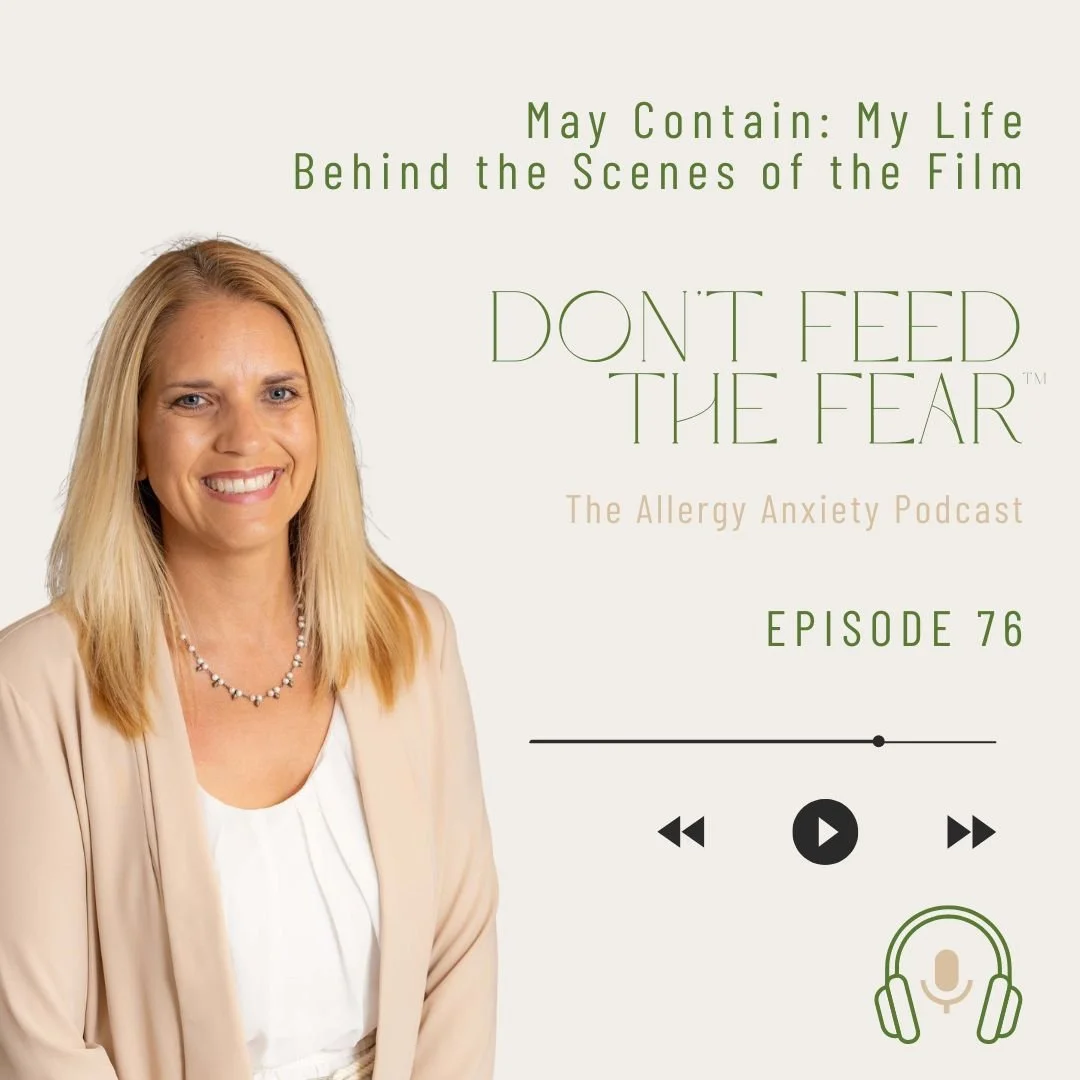
May Contain: My Life - Behind the Scenes with Mandi Kearns
This week on the podcast, I’m joined by filmmaker and advocate Mandi Kearns of Just Like You Films to discuss the upcoming food allergy docudrama, May Contain: My Life.
This conversation explores not only the making of the film, but the emotional realities behind it: parenting through food allergies, navigating fear and resilience, sibling experiences, emergency situations, advocacy, and the ways these experiences continue to live in our nervous systems long after reactions are over.
One of the things I appreciated most about this film is that it does not portray individuals with. food allergies as fragile or broken. Instead, it honestly captures the complexity of living with food allergies while still centering resilience, identity, connection, humor, and humanity.
This is an incredibly meaningful conversation for food allergy parents, adult patients, providers, advocates, and anyone wanting to better understand the lived experience of this community